
Mechanical Seal Parts & Components: Anatomy of a Pump Seal
Table of Contents
Primary Sealing Components
A mechanical seal is a compact assembly of precision parts with one job: keeping the pumped fluid inside the pump where the shaft passes through the casing. Despite the variety of designs on the market, every mechanical seal is built from the same handful of components — a rotating face, a stationary face, a spring or bellows, a secondary elastomer seal, and the hardware that ties them to the shaft and the gland. Understanding what each part does makes it much easier to order the right spares, diagnose a leak, or compare two quotes.
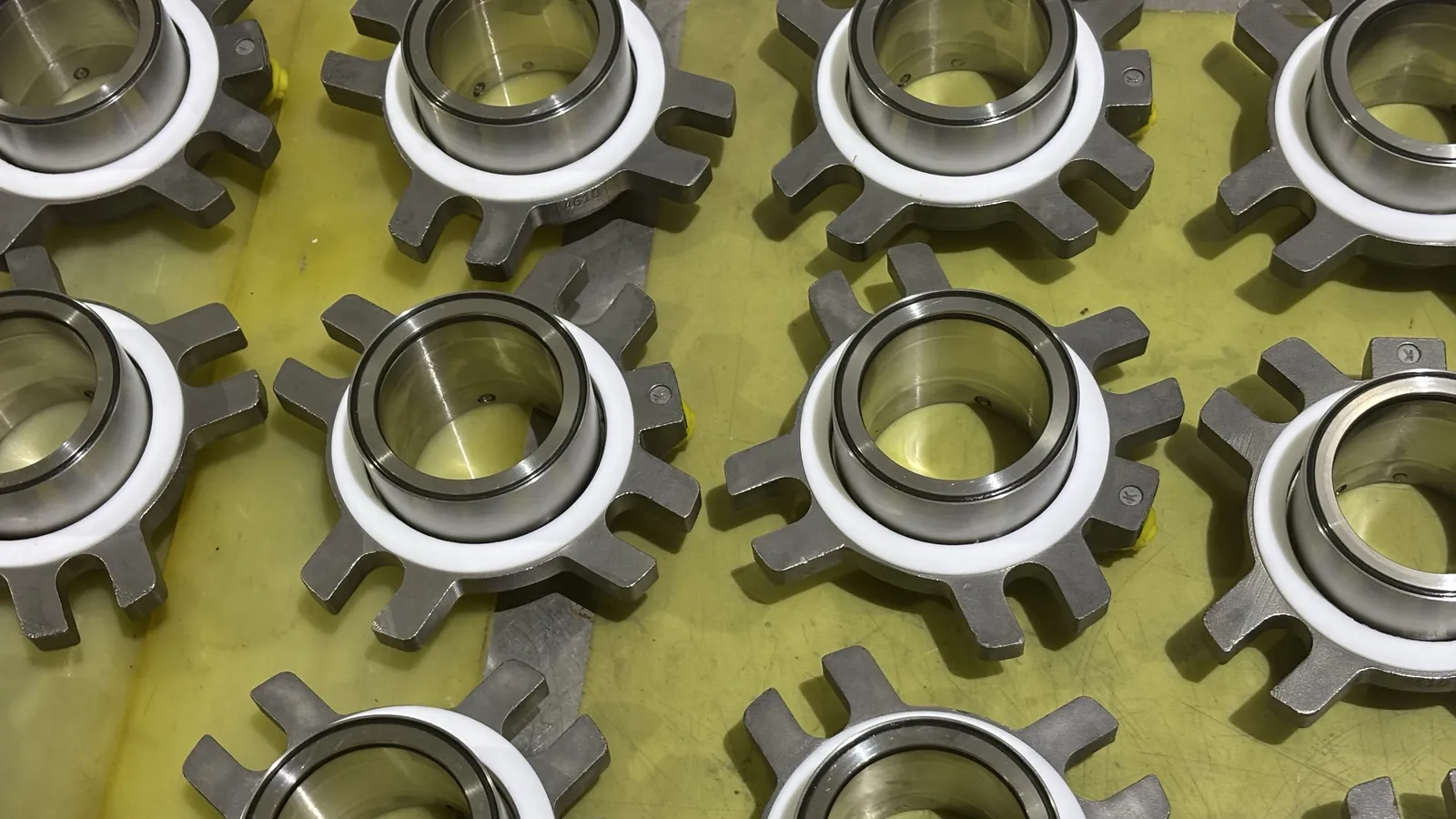
The primary sealing pair is where the actual sealing happens: a rotating face driven by the shaft, and a stationary face held in the gland, lapped flat and pressed together by spring force. Between the two faces runs a microscopic film of the pumped fluid — the film that lubricates them and keeps them from grinding into each other. Everything else in the assembly exists to keep that pair aligned, loaded, and leak-tight against both the shaft and the gland.
Around the faces sit the support parts: springs or a bellows supply closing force, elastomer rings (O-rings, wedges or V-rings) seal the static joints at the shaft and gland, a sleeve protects the shaft, and the gland bolts the stationary parts to the pump. Each component has a defined job and its own failure mode, so the sections below look at them one by one.
Seal Faces: The Pair That Does the Work
The faces are the heart of the seal and usually its most expensive parts. One face rotates with the shaft, the other stays fixed, and the two are lapped flat to within a fraction of a micron so they can run against each other with a fluid film between them. The face material pairing matters more than almost any other selection decision, because the pair must survive the media, the temperature and the rubbing speed together.
The workhorse combination for clean water and light chemicals is carbon against silicon carbide (SiC): the carbon is self-lubricating and wears preferentially, protecting the harder SiC face. For abrasive water or slurries, SiC against SiC or tungsten carbide against SiC resists wear better. Ceramic faces handle mild chemicals and are common in smaller pumps, while PTFE-faced seals trade wear life for chemical resistance. Shaft diameters in this range typically run from roughly 10 mm on small dosing pumps up to 100 mm and beyond on large process pumps — confirm your exact dimensions with your supplier.
| Face Pair | Typical Service | What to Know |
|---|---|---|
| Carbon vs SiC | Clean water, hot water, light chemicals | Workhorse combination; carbon wears preferentially and is cheap to replace |
| SiC vs SiC | Abrasive water, mild slurries | Very hard and wear-resistant, but needs reliable lubrication to survive dry running |
| Tungsten carbide vs SiC / carbon | Heavy solids, abrasive slurries | Highest wear resistance at a higher price |
| Ceramic vs carbon | Light chemicals, small pumps | Cost-effective; more brittle and less forgiving of shock loads |
| PTFE vs ceramic / SiC | Aggressive chemicals | Excellent chemical resistance; wears faster and has lower pressure-speed limits |
Two numbers are worth knowing. Face flatness after lapping is typically on the order of a single light band — roughly 0.3 micrometres — which is why faces must be handled carefully. The practical speed and pressure limit of a face pair is set by its PV value, the product of face pressure and sliding velocity. When both are high, the faces generate heat that the pumped fluid or a flush must carry away — which is why high-duty seals are engineered per application rather than picked from a table.
Springs and Drive Mechanisms
The spring (or bellows) supplies the closing force that keeps the faces in contact when the pump is stopped and when hydraulic pressure drops. A single large spring is simple and robust and suits clean, non-clogging media; multiple small springs distribute the load more evenly across large faces but can clog in solids-laden fluids. A metal or elastomer bellows replaces the coil springs entirely — with no small springs to clog and no dynamic O-ring on the shaft, bellows designs are a common answer for corrosive, polymerizing or high-temperature service.
Drive is the part buyers most often overlook. The rotating face has to be positively driven, not just pushed along by friction: drive pins, drive collars or a drive sleeve transmit torque from the shaft to the rotating face. A seal that slips at start-up generates heat and can damage the faces before it ever seals properly. Check that the drive arrangement suits your shaft — keyed shafts, threaded shafts and plain shafts each suit different drive hardware.
Spring compression is set by the manufacturer and should not be "tightened" on site. Too much spring load increases face wear and heat; too little lets the faces separate and leak. Cartridge seals remove this variable entirely by pre-setting the compression at the factory, which is one more reason they suit plants where installer experience varies.
Elastomers and Secondary Seals
Secondary seals stop fluid leaking along the shaft and between the stationary parts — they handle the sealing the faces cannot. The most common are O-rings, followed by wedge-shaped seals and V-rings. O-rings are simple and cheap; wedge seals are common on smaller pumps, where the wedge doubles as the drive for the rotating face. The elastomer must survive the chemical and the temperature, and it is usually the first part to fail when it does not — so the elastomer choice deserves as much attention as the face material.
Four material families cover most industrial service. NBR (nitrile) is the economical default for water, oils and general duty; EPDM suits hot water, steam condensate and mild chemicals; FKM (fluorocarbon) handles oils, fuels and many chemicals at higher temperature; PTFE and FFKM extend into aggressive chemical service at a premium price. The ranges below are typical — confirm the exact grade against your supplier's chemical compatibility data for your specific media.
| Elastomer | Typical Temp Range | Typical Service |
|---|---|---|
| NBR (nitrile) | -30 to 100 °C | Water, oils, general industrial duty |
| EPDM | -40 to 150 °C | Hot water, steam condensate, mild chemicals |
| FKM (fluorocarbon) | -20 to 200 °C | Oils, fuels, many chemicals |
| PTFE | -60 to 200 °C+ (media-dependent) | Aggressive chemicals; limited spring return, often used as a wedge or jacket |
| FFKM (perfluoroelastomer) | -10 to 300 °C+ | Aggressive chemicals at high temperature; premium price |
Temperature and chemical attack arrive together in practice: an elastomer run continuously near the top of its range will age faster even if the chemical is compatible on paper. That is why suppliers ask for the actual operating temperature rather than the pump nameplate. Treat the table as the starting point of a conversation, not a specification on its own.
Sleeves and Glands
The shaft sleeve protects the shaft where the seal runs. On many pumps the seal rides on a sleeve rather than directly on the shaft, so wear, corrosion and fretting damage the sleeve instead of the shaft — a much cheaper part to replace. Sleeves may be fixed to the shaft with keys or pins, or the seal may run directly on the shaft where the shaft material is hard enough. When you order a replacement, note whether the original ran on a sleeve and record its outside diameter.
The gland holds the stationary face and bolts to the pump. A standard gland is a flat ring machined with the seal bore, bolt holes and usually a flush or quench port; a cartridge gland is a complete housing that carries the sleeve, faces and springs as one pre-set unit, so the seal installs without measuring spring compression. Glands differ in bore size, bolt pattern and flush connection type, so the gland dimensions must match the stuffing box — not just the shaft size.
Two measurements cause most wrong orders: the stuffing box bore (the opening the gland covers), its depth (how far the seal sits inside), and the bolt circle. A seal with the right shaft size but the wrong bore simply will not fit. If you are replacing an old seal, measure the old unit and read its markings — which leads naturally to part numbers below.
What's in a Seal Kit?
A seal kit (or repair kit) is how most plants buy spares, because it bundles everything that wears into one box. Kits are sold for a specific seal size and usually cover a single service — confirm the elastomer rating, because the same seal size is often offered with NBR or FKM at different prices. A typical kit contains:
- Rotating and stationary faces (the primary pair), already lapped as a set
- Springs — single or multiple, or a bellows assembly where applicable
- All elastomers: shaft O-ring, gland O-ring, wedge or V-ring, plus spares
- Drive pins, drive collars or a drive sleeve where part of the design
- Set screws, washers, retaining rings and other small hardware
- Installation instructions or a data sheet with the correct compression setting
What kits usually do not include is the gland, the shaft sleeve and the flush connections, which are reused across several seal changes. When you order, confirm whether the kit is for a standard or cartridge gland and whether the sleeve is included — "kit" means different things to different suppliers, and the difference only shows up at install time.
Identifying Parts by Part Number
Every mechanical seal carries identifying markings, usually stamped on the gland or the stationary seat. Part numbers follow a loose industry convention: the first group usually identifies the seal family or series, the middle groups encode shaft size and face or elastomer codes, and a suffix covers spring material or drive configuration. Conventions vary by manufacturer, so treat any decoding as a strong hint rather than a guarantee.
The reliable way to identify a seal combines three things: the markings on the old unit, its measured dimensions (shaft diameter, seal bore, installed height, gland bolt pattern), and the pump model. With those, a supplier can normally match the seal family and offer the correct replacement. Be cautious with cross-reference lists that claim one number replaces another brand's number — two numbers can look equivalent on paper and differ in bore or installed height. Confirm the physical dimensions before you order.
For genuine replacement parts, the safest route is to order against the original seal's own part number from the same manufacturer, or to send the supplier the pump details and let them confirm. If the seal has been in service for years, ask whether the manufacturer has revised the design — a newer series may fit the same stuffing box with better materials, and that question costs nothing before you commit to old-stock spares.
Part-Level Selection Notes
When you buy parts rather than a complete seal, match every dimension, not just the shaft. The bore, installed height and gland bolt pattern must fit the stuffing box; the face material must suit the media; the elastomer must suit the temperature. Changing one material in isolation can unbalance the design — a harder face pair, for example, changes the heat generated at the faces and the lubrication needed. Run through this list before ordering:
- Shaft diameter at the seal location, and whether a sleeve is fitted
- Stuffing box bore, depth and gland bolt pattern
- Media, concentration and temperature range — actual values, not nameplate
- Pressure at the seal, typically the stuffing-box or discharge pressure
- Existing flush or quench arrangement and connection sizes
- Whether the original was a component or a cartridge design
Two honest notes. First, "upgrading" a single part of an old seal — say, swapping the elastomer — usually works only if the rest of the assembly is still in good condition; faces and springs wear too, and mixing new and worn parts shortens the life of both. Second, prices differ widely between genuine, OEM-equivalent and aftermarket parts, and material quality and lapping quality are exactly where the difference shows. Ask what you are buying, and confirm the fit before you order.
When in doubt, buy the complete assembly or the kit rather than individual parts. The premium is small compared with a failed install or a second downtime, and cartridge units arrive with the manufacturer's settings — spring compression, face alignment — already done.
FAQ
Quick answers to the questions buyers and maintenance teams ask most often about seal parts.
- Which parts wear out first? The elastomers and the carbon face are usually first, because they see chemical attack, temperature and rubbing contact together. Springs fatigue over time, while SiC and tungsten carbide faces typically last longest — which is why kits bundle faces and elastomers together.
- Can I replace just the faces and keep the rest? Yes, if the gland, sleeve and springs are still in good condition and the dimensions match. Many plants replace the whole kit at the same time because the labour to change a seal dwarfs the cost of the extra parts.
- Do replacement parts have to be the same brand as the original? Not always — OEM-equivalent and aftermarket parts exist for most common sizes. But the fit, material grade and lapping quality must be verified, so confirm the dimensions and material codes with your supplier before ordering.
- How do I know which elastomer is fitted? Most manufacturers mark the elastomer with a colour band or a code on the ring itself, and the part number usually encodes it too. If the markings are worn, the supplier can identify the grade from the seal series and the service.
- Should I buy a full seal or just a kit? A kit is the right call for planned maintenance when the gland and sleeve will be reused and their condition is known. If you are unsure about the condition of the existing hardware, or the seal is a cartridge, buy the complete assembly.
- Can I convert a component seal to a cartridge unit? In most cases yes, if the stuffing box bore and gland fit a cartridge housing. Many cartridge seals are direct replacements for common component sizes — check the bore and shaft details with your supplier before ordering.
Need help matching the right seal? Contact us with your pump model — we confirm the fit before you order.
NEXT STEP
Ready to Upgrade to Mechanical Seal Solutions?
Send us your requirements — our team responds within 24 hours with pricing and lead time.
Written by
Ray ChanMechanical Seal Buyer's Guide Author · Mechanical Seal Solutions Specialist. Ray helps global importers and integrators source factory-direct mechanical seals.